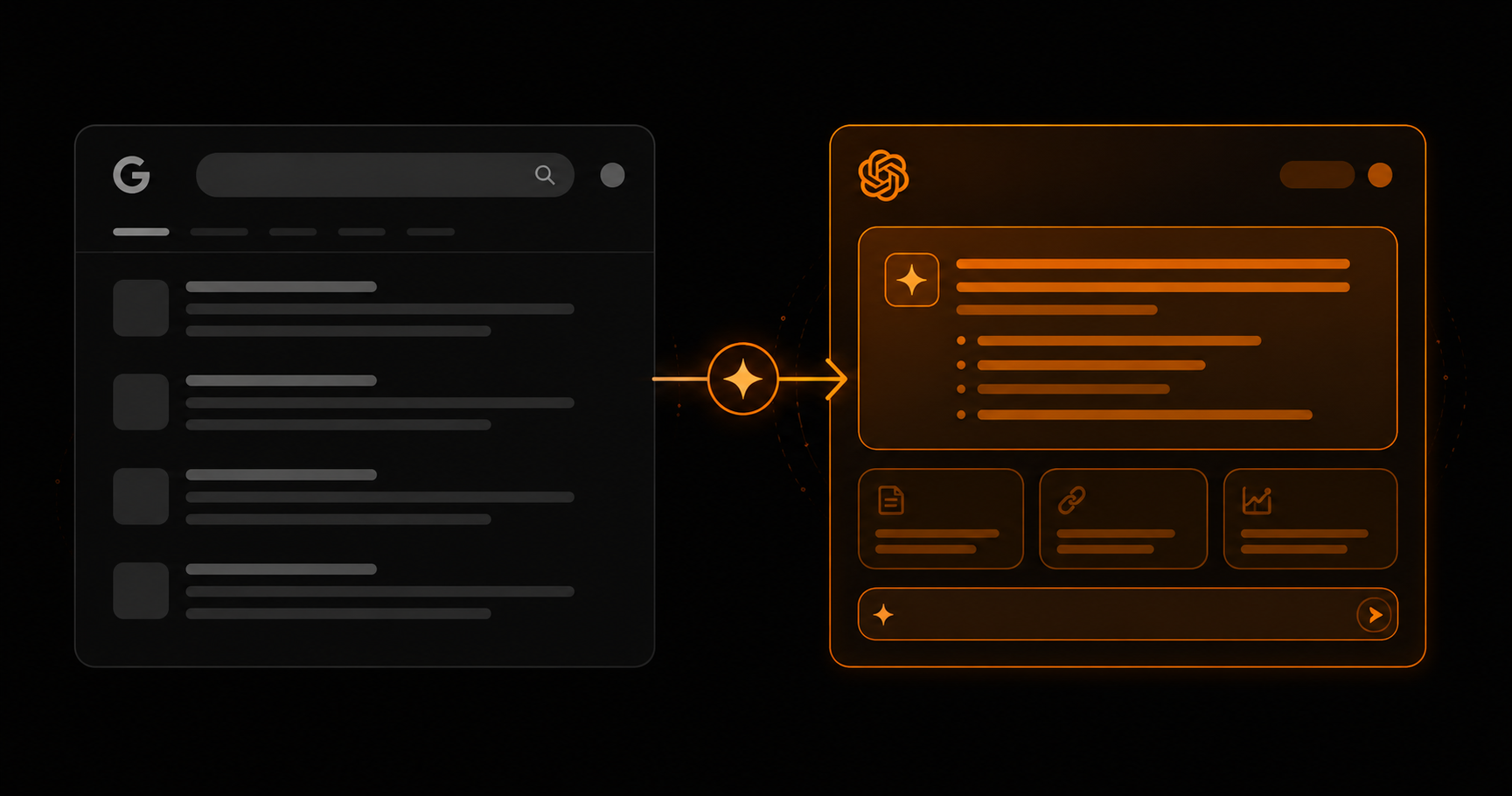
I typed a simple query into ChatGPT: "fractional CMO specialising in AI marketing Europe".
My name did not appear.
That is a practical commercial problem. The founder I want to reach may not start with Google any more. They may ask ChatGPT, Perplexity or Claude who they should speak to. If those systems cannot identify me, I am absent from part of the buying journey.
That is the AEO problem I care about.
What AEO means in practice
Answer Engine Optimisation is the work of making a person, company or product easy for AI systems to identify, understand and cite.
SEO still matters. Pages need to be crawlable, fast, structured and useful. AEO adds another layer: clear entity definition, structured data, answer first sections, accessible source pages and external corroboration.
The practical question is simple: if an AI engine has to answer a buyer's question in my category, have I given it enough clear evidence to include me?
The starting point
For a personal consulting site, the entity needs to be unambiguous.
For me, that means the same core description appearing consistently across the site and relevant external profiles:
Mark Little is a fractional CMO based in Lisbon, working with UK, European and US West Coast teams to build AI marketing systems, GTM infrastructure and agentic marketing workflows.
That description has to show up in places machines can read. The homepage, metadata, schema, llms.txt, LinkedIn, podcast notes, guest posts and indexed articles should all reinforce the same picture.
If one source calls me an AI consultant, another calls me a growth advisor, and another calls me a tech CMO, the evidence becomes weaker than it needs to be.
What I changed on the site
The first pass was basic but important.
- Person schema on the site, with a clear description of role, location and expertise.
- BlogPosting schema on articles.
- FAQ content that answers commercial questions directly.
robots.txtallowing major AI crawlers.llms.txtdescribing who I am, what I do and which pages matter.- Clearer homepage positioning around fractional CMO work and AI marketing systems.
- More article content around the actual systems I am building.
None of this is magic. It is structured evidence.
The seven checks I now use
1. Entity definition
Can a crawler quickly understand who I am, what I do, where I work and who I serve?
This has to be written plainly. Clever positioning is useful for humans, but machines need repeated, consistent terms.
2. Structured data
Does the page contain schema that identifies the person, article, FAQ or organisation accurately?
Schema is not a substitute for good copy, but it reduces ambiguity.
3. Answer first sections
Can a useful answer be extracted from the first sentence of a section?
This is especially important for FAQ content. If the answer is buried behind a long setup, it is harder to cite.
4. Crawlability
Can AI crawlers access the site, sitemap and important pages?
AEO is impossible if the useful pages are blocked, buried or invisible.
5. Freshness
Is the site alive?
Publishing regular, useful material gives crawlers more recent evidence. I would not claim a fixed three month rule without better data, but stale sites are clearly weaker than active ones.
6. External corroboration
Does the same entity appear outside the website?
LinkedIn, podcast transcripts, guest posts, citations, client references and conference pages all help confirm that the person or company exists beyond its own domain.
7. Query monitoring
Do target queries return the right answer?
The only honest way to know is to test. I track whether AI engines mention me, which competitors appear, what language they use, and which source pages they cite.
How to measure it
I would start with a short list of buyer intent queries rather than a dashboard full of vanity metrics.
Examples:
- fractional CMO for AI marketing systems in Europe;
- fractional CMO for B2B tech startups;
- AI marketing agent consultant for Series A companies;
- answer engine optimisation consultant for founder led B2B companies;
- agentic GTM systems for startups.
Run the same queries every week across ChatGPT, Perplexity and Claude. Track three things: whether your name appears, which sources are cited, and how accurately the answer describes what you do.
That is enough to start.
The bottom line
AEO builds on SEO. It is the next layer of discoverability for buyers who ask AI engines before they click through to websites.
The work is not complicated. Define the entity. Mark up the pages. Write direct answers. Allow crawlers. Publish useful material. Build external citations. Monitor the queries that matter.
The goal is commercial evidence, not traffic for its own sake. When a founder asks an AI engine who can help them build AI marketing systems, the answer needs enough evidence to include me.
That is what I am building towards on mark-little.com.
Want this built for your business?
Practical marketing infrastructure, running on your data, in your voice, with approval gates where they matter.
Book a discovery call